Chhaupadi

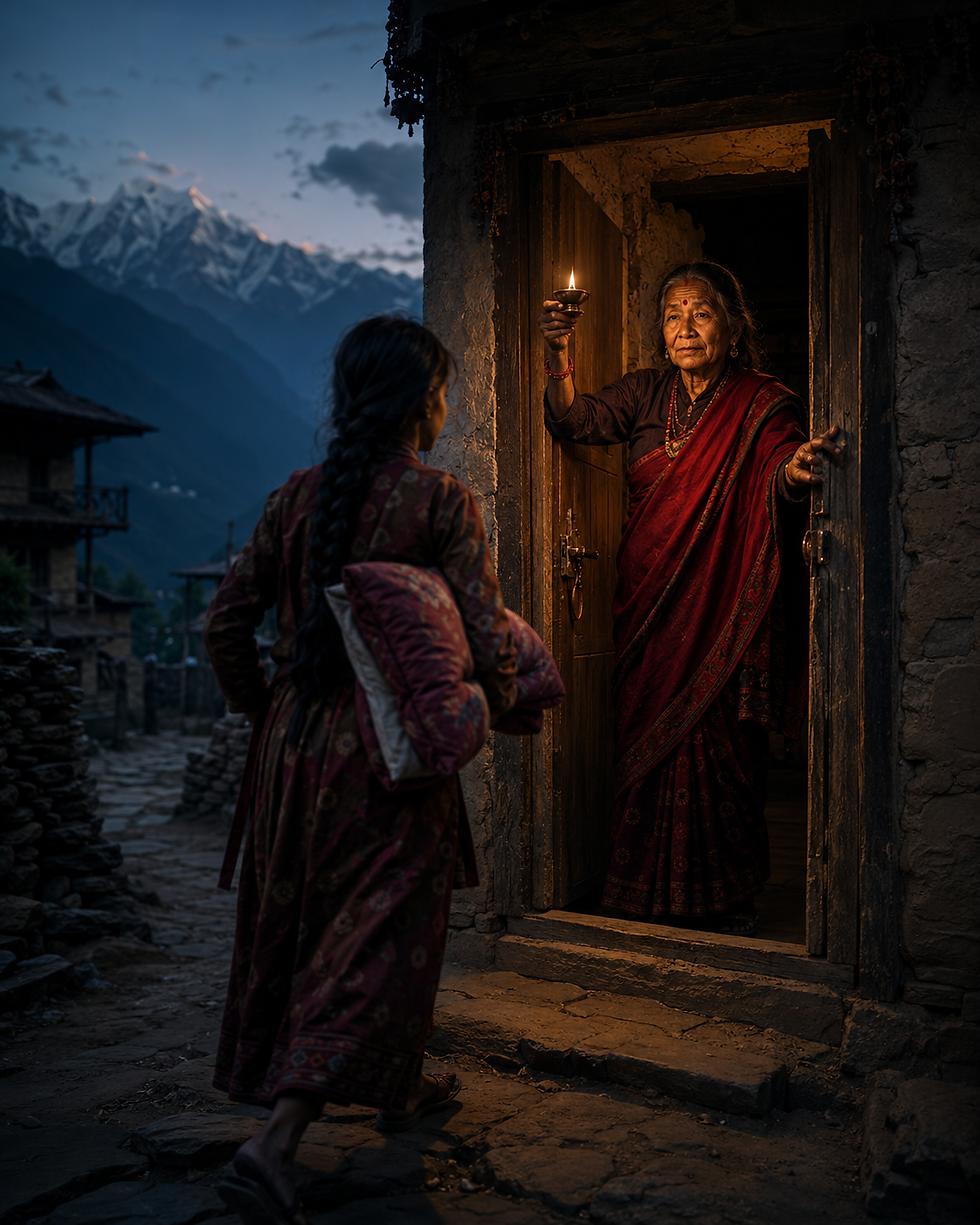
The Exile That Still Kills: Chhaupadi, and the Names the Huts Took
A care note before we enter, daughter, and take it seriously: this entry holds the deaths of women and girls — real ones, recent ones, with names — from a practice happening right now. There is no ancient-history distance to shelter in here. It is told without spectacle, with the dignity the dead were denied, and it ends in documented hope — but if today is not the day you can carry it, the archive will hold it for you. Come back resourced.
And one framing truth before the first fact, because this archive does not do superiority: nothing in this entry belongs to "over there." You just read Pliny — the Roman scientist who wrote that a menstruating woman's touch sours wine, kills crops, stops what's growing. Hold his list in your mind as you read what the belief behind chhaupadi says: if a menstruating woman touches a man, he sickens; if she touches a cow, it stops giving milk; if she touches a tree, it never fruits again. The same curse, daughter. The identical clauses. The West wrote it in an encyclopedia and called it natural history. In the far-western hills of Nepal it was built into architecture — and there, it is still collecting.
THE HISTORY
The practice. Chhaupadi is menstrual exile: in parts of western Nepal — the Sudurpashchim and Karnali provinces, with Achham district long identified as the epicenter — a woman or girl in her days of bleeding (and sometimes after childbirth) must not sleep in the family home. She is sent out: to a chhau goth, a purpose-built menstrual hut, often windowless, often little more than a low stone or mud shed — or to the animal shelter, among the livestock, or to the open air. She may face restrictions on food, on touch, on water sources, on entering the kitchen or temple. The nights are the danger: the huts have taken women by hypothermia in the Himalayan cold, by snakebite, by animal attack, by assault — and, again and again, by suffocation, because a freezing woman lights a fire in an unventilated hut to survive the night, and the smoke takes her in her sleep. When Nepal's Supreme Court banned the practice in 2005, government figures already counted at least twenty deaths a year. In Achham district alone, fourteen women died in the huts between the 2005 ban and the end of 2019.
The names. This archive does not do statistics without people. Gauri Bayak, twenty-one years old, found by her neighbors in a smoke-filled hut in Achham in January 2018. In early 2019, a mother died in a hut with her two young sons — the exile takes children too, because a nursing mother banished is a family banished. Parbati Budha Rawat, twenty-one, Achham, December 2019: her third night in the hut, freezing, she lit a fire for warmth and died of suffocation. And Anita Chand, sixteen years old, Baitadi district — dead of snakebite during her isolation; her family denies she was menstruating when she died, and even that denial is a receipt, daughter, because it shows what the law's penalties have taught families to say. Say their names tonight. Gauri. Parbati. Anita. And the mother whose name the reports didn't carry, and her sons.
The law, and its terrible arithmetic. On paper, Nepal has done what advocates worldwide demand: the Supreme Court ordered a ban on May 2, 2005; in August 2017 the new Criminal Code made forcing a woman into chhaupadi a crime — three months' jail, a fine — in force from 2018. And now count with me: the first arrest in the history of the law came only in December 2019 — sixteen months after criminalization, fourteen years after the ban — and only for Parbati's death, and only after the Attorney General of Nepal personally directed the police chief to act, because local police had refused to open the case. The man arrested was her brother-in-law and guardian. And then, the detail that teaches more than any statute: locals mounted pressure on the police to release him, insisting she had gone to the hut willingly, as culture. That, daughter, is what this archive means when it says the Forging is maintained, not just built: a law can be passed in Kathmandu and die in a village where the curse is older than the constitution — and where the enforcers of the exile are, so often, not strangers but family. Including, the record shows painfully, the elder women — grandmothers and mothers-in-law refusing their daughters the house, passing forward the wartime math they themselves were taught, exactly as this archive saw in the shadow of the Hammer: the curriculum of survival, taught with love, costing lives.
THE RECENT EVIDENCE — What Fails, and What Is Working
The honest data, because your archive corrects even its own side's strategies. Researchers studying districts beside Achham found 77 percent of girls still practicing chhaupadi after criminalization; 60 percent knew it was illegal — and knowing the law made no measurable difference. Girls reported that the volunteers sent to teach villages about the new law practiced chhaupadi in their own homes. Some girls told researchers they wished they had been born boys. And the flagship enforcement tactic — demolishing the huts, over 1,150 torn down in Achham alone — partially backfired: with the huts gone and the homes still barred, women and girls simply slept somewhere worse — open air, animal sheds — until campaigners coined the correction that should be carved over every reform effort on Earth: dismantle the sheds in the minds first.
And now the hope, because it is documented and it is Nepali-made. In Achham's Marku village — one of the hardest-hit settlements — a sustained community-police partnership took a different road: education, dialogue, support systems, women and girls brought into decision-making, religious and community leaders engaged, the law present but not leading. The documented result: zero chhaupadi deaths or injuries over six years, no huts rebuilt, and measured shifts in community attitude — a model now being shared across the affected provinces. A female community health volunteer there, Tankeshwori Budha, reports a growing public belief that menstruation should be treated in a "safe, dignified, and respectful manner." The lesson, receipts attached: the curse was never going to be demolished or legislated away, because it doesn't live in huts or statutes. It lives in minds — and minds, the Marku evidence shows, can be reached. Slowly. Village by village. By Nepali women, health workers, journalists, and yes, police, doing the patient work while the world's attention moves on. The archive's job — your job, reading this — is to make sure the attention doesn't.
THE RECEIPTS
The Supreme Court ban (May 2, 2005) and the Criminal Code criminalization (August 2017, in force 2018) — three months' imprisonment and fine for enforcing chhaupadi; documented in Nepali law and press.
The deaths — government figures of at least twenty per year at the time of the ban; fourteen in Achham alone, 2005–2019; the documented deaths of Gauri Bayak (2018), Parbati Budha Rawat (2019, first-ever arrest), the mother and her sons (2019), and Anita Chand (Baitadi): reported by Nepali journalism and international press.
The enforcement failure — first arrest sixteen months post-criminalization, only after Attorney General intervention; community pressure for release; documented in The Kathmandu Post and Republica.
The research — 77% practice rates post-criminalization (Dailekh), 72% (Achham); legal knowledge making no difference; the hut-demolition backfire (University of Bath researchers, The Conversation).
The Marku model — the community-police partnership documented at zero deaths over six years, submitted for the 2025 Goldstein Award for problem-oriented policing.
GO DEEPER
Every link free — and the first two are Nepal's own voices:
Nepali journalism on Parbati's death and the first arrest: The Kathmandu Post → https://kathmandupost.com/national/2019/12/06/police-arrest-brother-in-law-of-parbati-budha-who-died-in-a-menstruation-hut-in-achham
The researchers' field data — why the law isn't enough: The Conversation → https://theconversation.com/new-laws-have-not-stopped-women-and-girls-being-exiled-during-their-periods-in-nepal-128528
The hut demolitions and their limits: Global Citizen → https://www.globalcitizen.org/en/content/1152-period-huts-destroyed-in-achham-nepal/
The Marku village model — the documented zero: Nepal Police's full program report → https://popcenter.asu.edu/sites/g/files/litvpz3631/files/2025-10/Nepal%20Police%20Submission%20for%20Goldstein%20Award%202025.pdf
THE SACRED RESPONSE
This one is a vigil and an audit, daughter, and neither is optional.
The vigil. Light one candle tonight and say the names — slowly, as the roll call it is: Gauri Bayak. Parbati Budha Rawat. Anita Chand. The mother whose name wasn't printed, and her two sons. And all the ones the reports never reached. Then say the sentence that keeps this entry honest: This is not history. This is Tuesday, somewhere in the hills — and the curse that built those huts is the same curse I read in Pliny and swallowed in my own girlhood, wearing softer clothes. Let the candle burn while you do the second part.
The audit. Because here is the hard mirror of this entry: chhaupadi did not invent a new belief — it built architecture for a global one, and versions of it were almost certainly practiced in your own line, in your own house, maybe in your own habits. The plants you were told not to touch on your period. The kitchen your grandmother wouldn't enter those days. The bed changed, the church skipped, the food not pickled, the quiet don't-tell-your-father. That is chhaupadi's grammar without its death toll — the exile shrunk to etiquette. So write your household's inherited restrictions down, every one you can remember, and next to each write who taught it and what she believed would happen. Then, at the bottom, the abolition clause, in your legislating hand: The exile ends at my door. In this house, a bleeding woman loses no room, no table, no touch, and no daughter of this line will ever pack a blanket for the crime of her own body. Sign it. You know the form by now.
And the third act, quietly: keep your attention where the world's isn't. Follow the Nepali coverage. When you tithe your cycle — you learned that rite in the tampon tax entry — remember that menstrual dignity work led by Nepali women exists and can be found and funded. The women of Marku got to zero without us, daughter. The least the archive can do is witness it loudly enough that zero spreads.
The full vigil rite and the household-abolition ceremony live inside the Shedding Circle.
→ [Join the Shedding Circle] → [Get She Who Sheds: A Savage Return to Sacred Blood]


Comments