Monk's Pepper

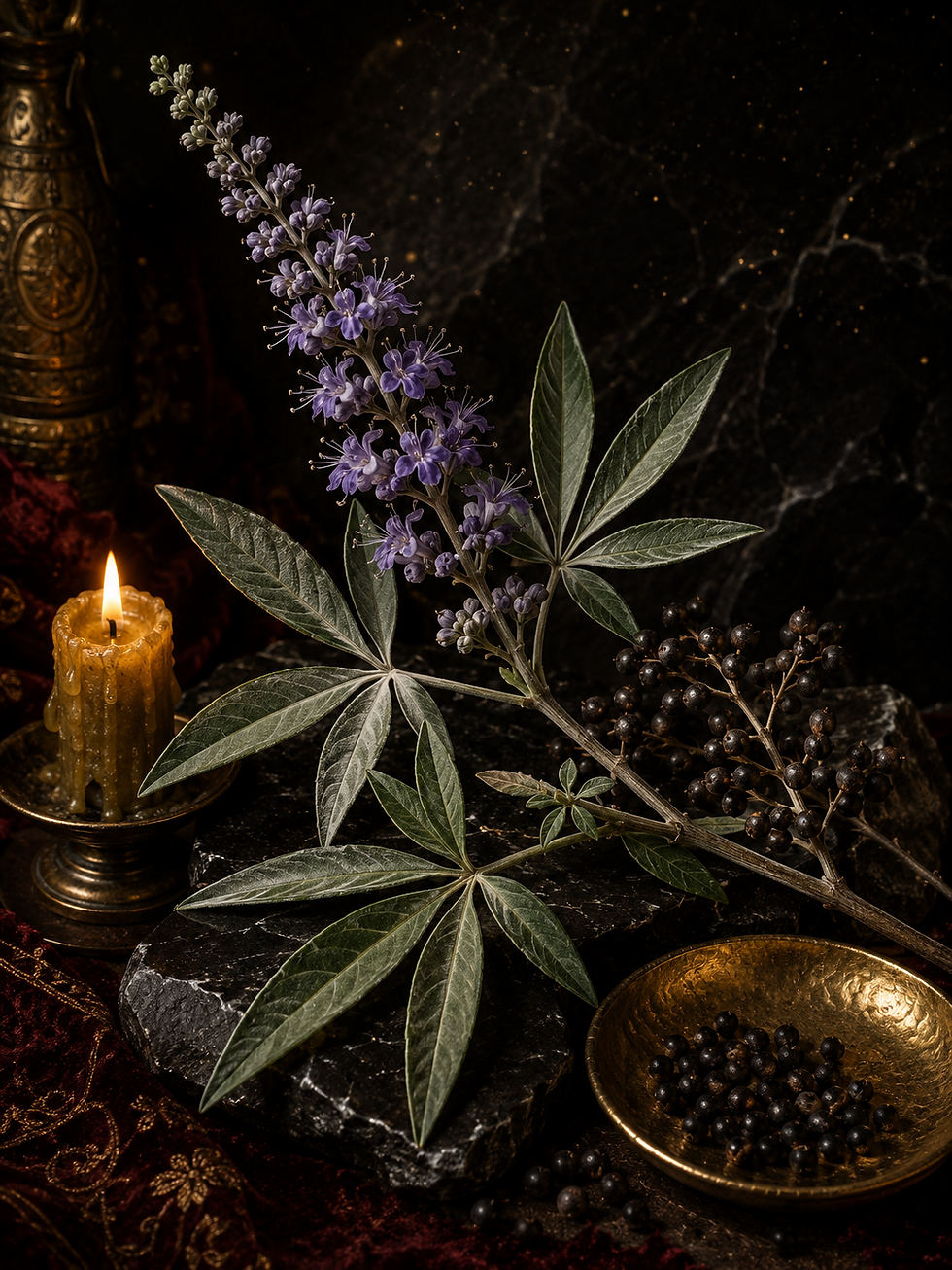
VITEX (CHASTE TREE)
Vitex agnus-castus — Monk's Pepper, the Chaste Lamb, Vencedor
Streams: The Ancient Apothecaries · The Wise Women & The Burned Folk & old names: Chasteberry · Chaste Tree · Monk's Pepper (Mönchspfeffer) · Abraham's Balm · Wild Pepper (piper silvestre) · Vencedor ("the Winner")
They named her twice for chastity — once in Greek, once in Latin — and strewed her on the beds of women and monks to kill the want in them. Funny thing: she was never a cage. She's a key. She sets the whole cycle back in tune.
⚠ SAFETY — READ BEFORE YOU REACH FOR HER. Vitex works directly on your hormones (it acts on the pituitary and lowers prolactin), so treat her with real respect. Do not use her in pregnancy, while breastfeeding, or while trying to conceive without a provider guiding you. HIGH-STAKES INTERACTION: she may reduce the effectiveness of hormonal birth control — an unintended pregnancy has been reported on Vitex plus a progestogen-only pill — and may interfere with HRT and fertility treatment. Because she's dopaminergic, she can clash with antipsychotics, metoclopramide, and Parkinson's medications. She's not right for very high prolactin from a pituitary tumor. She works slowly (about three cycles, taken daily) — not an as-needed herb. This entry is traditional and educational — not medical advice. Consult a qualified provider. The reverence does not soften the warning.
THE OLD KNOWING
Her name is a two-thousand-year-old argument about desire. Vitex comes from the Latin vieo, "to weave or bind" — for her long, pliable branches, once woven into baskets and wattle fences. But agnus-castus is the tell: it says "chaste" twice, folding the Greek agnos (chaste) into the Latin castus (chaste) — with a tangle of old misreadings along the way (ágonos, "without offspring"; agnós mistaken for Latin agnus, "lamb" — hence "chaste lamb"). However you cut it, the ancients filed this small Mediterranean tree under sexual restraint.
And they meant it. Theophrastus, Dioscorides, Pliny, and Hippocrates all wrote of her. She was sacred to Hera (marriage), to Hestia/Vesta (the virgin hearth), and to Demeter — and it was at Demeter's great women's festival, the Thesmophoria, that the women of Athens laid her leaves on their beds to hold themselves ritually chaste (a fertility festival policed with a chastity herb — hold that paradox). The Romans drank a preparation of her seeds to cool desire. Then the medieval cloisters took her up: "monk's pepper," Mönchspfeffer — monks used her peppery berries as an anaphrodisiac and scattered her chaff in their sleeping quarters to keep their vows. In parts of Italy her flowers are still strewn on the paths novices walk today.
But that's only Europe's story. In the African diaspora — in Palo Mayombe and Santería/Lucumí — this same plant is Vencedor, "the Winner," and she belongs to Obatalá, the Orisha of the white cloth, father of all. (That attribution comes from living practitioner tradition rather than academic ethnobotany — but it matters: the plant Europe built into a chastity-cage, the diaspora crowned as victory.)
THE MAGIC
She was held sacred as the guardian of purity — the plant of the threshold goddesses who were virgin and mother and marriage all at once. The why behind the why is a genuinely fascinating near-miss: she really does act on the reproductive-hormonal axis, so the ancients felt her shift something in the body's cycles and named that shift "chastity." They were reading a real signal — they just read it wrong. The power they gave her (killing lust) is the one thing modern science can't confirm; the power that's real (retuning the whole cycle) they had no way to see.
And where the story got free — in the diaspora, as Vencedor, Obatalá's white-cloth plant — she isn't about denying the body at all. She's about winning.
THE SCIENCE NOW
Here's a plot twist for this archive: the science is actually good. Vitex is one of the most thoroughly researched botanicals in women's health — a real clinical file, not the usual "tradition deep, trials thin."
Her mechanism is specific: diterpene compounds in the berry bind D2 dopamine receptors in the pituitary and lower prolactin — and dose matters (low doses can raise prolactin, higher doses lower it). Bringing down a mildly elevated prolactin lengthens a too-short luteal phase and lifts progesterone — which is exactly why she helps the premenstrual body.
The trials back it. A 2013 systematic review (van Die and colleagues) of thirteen randomized controlled trials found that for PMS, most studies beat placebo — and beat vitamin B6 and magnesium too; for PMDD, one trial matched the antidepressant fluoxetine; and for latent hyperprolactinaemia, she normalized the luteal phase, raised progesterone, and in one trial performed comparably to the drug bromocriptine. Germany's Commission E approved her for menstrual irregularities, PMS, and cyclical breast pain, and the European Medicines Agency recognizes the standardized Ze 440 extract for PMS.
Honest caveats, always: the results are extract-specific (the studied Ze 440 isn't every bottle on the shelf), study quality varies, and she's wrong for very high prolactin caused by a pituitary tumor. But compared to most of this archive, Vitex is the rare women's herb the science actually showed up for.
THE BURIED TRUTH
She was never banned. Her burial is a lie told in her own name.
Agnus castus — chaste, chaste — is a monument to sexual control. She was enlisted by two of history's great institutions to police desire: Greek religion, which laid her on the beds of women to enforce ritual chastity in the cults of the virgin goddesses; and the medieval Church, which fed her to monks and strewed her in their cells to keep them celibate. A plant conscripted, for two millennia, to keep bodies — especially women's bodies — "pure."
And here is the truth that name buried: the chastity was never even proven. Science cannot confirm that Vitex dampens desire at all — the anaphrodisiac reputation she carried for two thousand years is pharmacologically unsupported. Meanwhile her real, testable gift is the opposite of a cage. She retunes the menstrual cycle, and by correcting a short luteal phase she has helped women conceive. Named to keep women chaste and childless-adjacent — she turns out to be a fertility ally. The label lied the whole time.
One more honesty, because this archive doesn't force its own refrain: Vitex wasn't buried by neglect. Unlike most women's herbs, she got the trials, the monographs, the respect. What got buried wasn't the plant — it was the truth of what she does, smothered under a very old story about controlling women's bodies. And the diaspora already knew better. It renamed her Vencedor — the winner. The chastity-cage, turned crown.
Traditional and educational content — not medical advice. Do not use Vitex in pregnancy, breastfeeding, or while trying to conceive without a provider, and never assume she's safe alongside hormonal contraception, HRT, or dopamine medications.
DIG DEEPER
van Die, Burger, Teede & Bone (2013), "Vitex agnus-castus extracts for female reproductive disorders: a systematic review of clinical trials," Planta Medica — the clinical evidence (PubMed ID 23136064).
European Medicines Agency (HMPC), assessment report & monograph on Agni casti fructus (chaste tree fruit) — well-established use for PMS, plus contraindications and interactions: ema.europa.eu (search "Agnus castus").
A.Vogel Plant Encyclopaedia, "Vitex agnus-castus" — for the Thesmophoria, "monk's pepper," and the tangle in the name: avogel.com/plant-encyclopedia.
RITUAL NOTE
How she lives now, in the old traditional framing: taken as a standardized berry extract or tincture, daily and patiently — about three full cycles — by those working with PMS, cyclical breast tenderness, and irregular periods. She's a slow-building hormonal ally, never an as-needed fix. On the altar she is the plant of the threshold goddesses and, in the diaspora, Vencedor — Obatalá's white cloth, the taste of victory. But honor her edges, because she moves real hormones: not in pregnancy, nursing, or conception without guidance, and never carelessly beside the Pill or hormone or dopamine medicines. Respect the herb that actually shifts the tide.
I Solemnly Swear To Teach As I Learn, For I Am Not A Sheep.
AILMENT TAGS: cramps · womb


Comments