Sappho's Nine Books

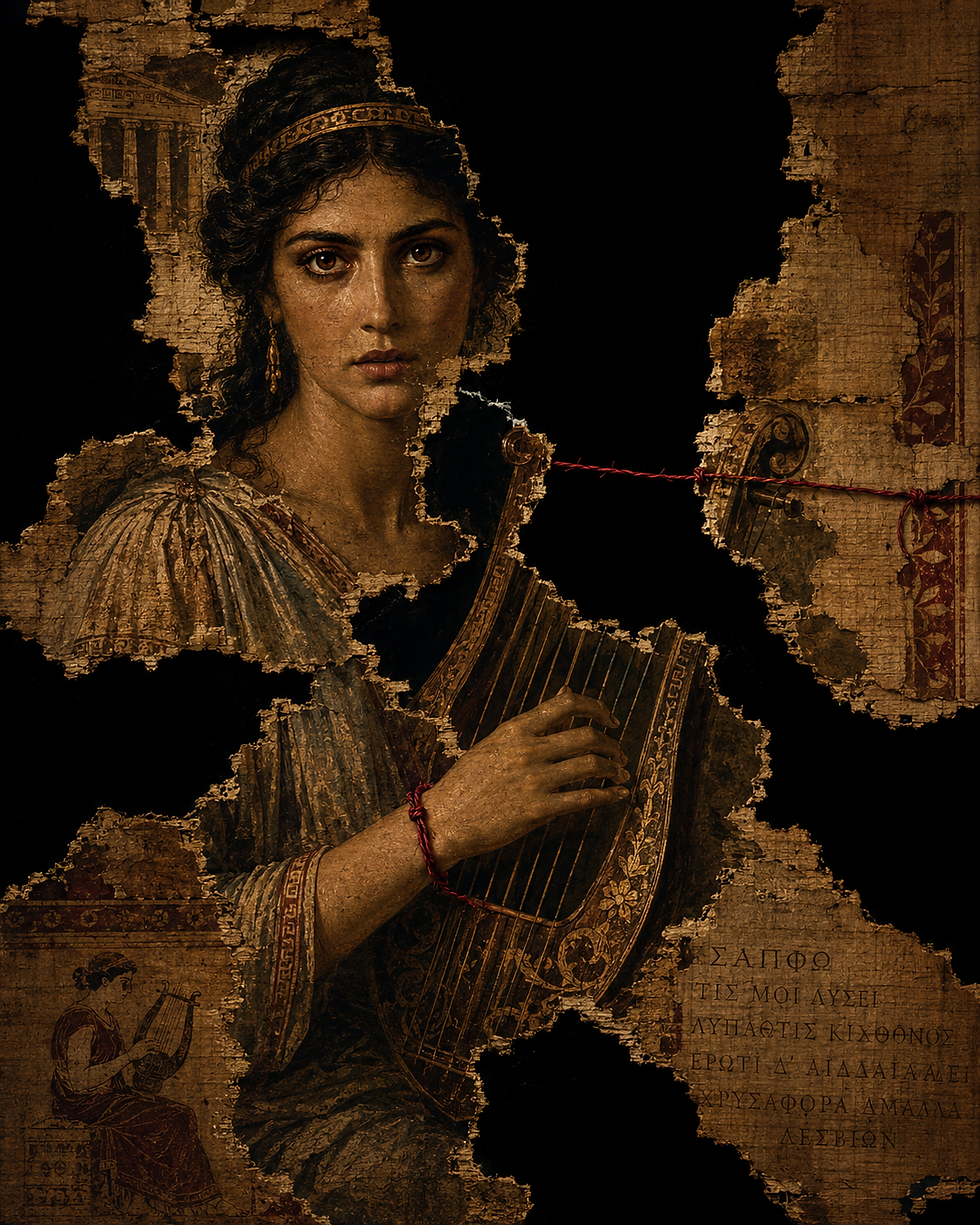
The Suffocation of the Tenth Muse: What Happened to Sappho's Nine Books
You have now seen the archive's whole toolkit of erasure, daughter: the chisel, the fire, the rename, the single edited verb. Tonight I show you the quietest instrument of them all — the one that took the greatest woman poet of the ancient world down from ten thousand lines to a handful of fragments, without a single decree surviving to blame. It's called not copying. The shrug. The century-by-century decision that her words weren't worth the scribe's time. And I'm going to tell you the truth about it even though the legend is more satisfying — because this archive has taught you by now that the documented story is always the more damning one. The fire you can fight, daughter. The shrug is the killer.
THE HISTORY
The nine books — the old layer. Sappho of Lesbos, born in the late seventh century BCE, wrote songs — love poetry of devastating intimacy, much of it about women, composed to be sung to the lyre, performed with dancing choruses; she's even credited by ancient sources with inventing the plectrum. Antiquity did not consider her a curiosity. It considered her a summit: she stands in the Hellenistic canon of the Nine Lyric Poets — the only woman — some ancient authors ranked her work alongside Homer's, and the epithet that followed her through the centuries was the Tenth Muse: not a poet among poets, but an addition to the divine roster. The scholars of Alexandria compiled her standard edition in the third or second century BCE: nine books, roughly ten thousand lines. A shelf. A life's cathedral of song.
Today, from those ten thousand lines, roughly six hundred and fifty survive. One single poem is complete. Of some fragments we possess exactly one word. And of the music — the melodies these words were made for, the lyre lines, the sound of her own art form — we possess nothing at all. Zero notes. Every song in this archive's music wing should observe a silence for that, daughter: the greatest songwriter of the ancient world survives only as lyrics torn from their dead songs.
The legend — and the truer story. Now, you have likely heard how this happened: that the Church burned her. The story circulates everywhere — Gregory of Nazianzus supposedly ordering her works destroyed around 380 CE, Pope Gregory VII allegedly finishing the job centuries later. And the archive's discipline requires me to tell you: the burning legend doesn't hold up. Historians who've hunted for contemporary evidence of these decrees come back empty-handed; the tales appear late and travel on their own drama. So strike the bonfire — but do not strike the hostility, because that part is documented: her homoeroticism and her unapologetically female point of view drew criticism in the conservative centuries after the Hellenistic age; comic playwrights mocked her; and the very first rewrite came early and tells you everything — the playwright Menander invented the story that Sappho killed herself leaping from a cliff for the love of a ferryman named Phaon. Sit with that, daughter: the woman whose surviving verses burn for women was posthumously assigned a death-by-heartbreak over a man. They didn't wait for the manuscripts to decay to start erasing her. They began with her meaning.
And then the manuscripts did decay — by the mechanism the record actually supports, which is colder than any bonfire. Her Aeolic Greek dialect grew difficult for later readers and stopped being taught. Tastes shifted. Papyrus crumbles on its own schedule. And at every copying junction — every generation's choice of which texts earned transfer to fresh papyrus, then into the new codex format, then into the medieval curriculum — Sappho kept losing the vote. Manuscripts of her poetry were still being produced into the seventh century CE; by the ninth, the trail goes cold. No villain signing an order. Just centuries of curators, overwhelmingly male, deciding — copy after copy, syllabus after syllabus — that the Tenth Muse could be let go. That is the Forging's quietest clause, daughter, and its most modern: most of what happens to women's work is not destruction. It is deprioritization, compounding annually, until the silence is total and nobody's fingerprints are on it.
How anything survived at all. Two routes, both accidental and both instructive. First: quotation — ancient critics and grammarians citing her lines to illustrate meter or sublimity; her famous Fragment 31, the poem of watching a beloved across a room while your body catches fire, survives because a critic quoted it in a treatise. Her words lived as evidence in other people's books — anonymous lodgers, like Porete's Mirror. Second: garbage — the ancient trash heaps of Oxyrhynchus in Egypt, whose dry sands preserved the papyri a town threw away, yielding fragment after fragment to modern excavation. Hold the pairing, daughter: what the curators declined to copy, the desert kept in the trash. Even the landfill was a better archivist than the libraries.
THE RECENT EVIDENCE — New Poems, and the Thief in the Recovery Room
And she is still arriving — which is where this entry earns its place in a living archive. In 2004, a Cologne papyrus brought the "Tithonus Poem" to near-completion. In 2014 came the announcement that made global headlines: the "Brothers Poem," nearly complete, on a papyrus published by the Oxford papyrologist Dirk Obbink. And now the honesty your archive owes you, because the recovery itself went dark: the 2014 papyri surfaced under circumstances contemporaries called sketchy from the start; the provenance story later collapsed — the publisher Brill formally retracted Obbink's chapter for presenting false information about where the Sappho papyri came from — and Obbink himself became the center of a wider scandal involving papyri allegedly stolen and sold from institutional collections, with scholars now openly debating whether every claim about the new fragments, down to authenticity itself, was ever independently verified. Most classicists still read the verses as Sappho's; the archive reports the cloud honestly and applies its own law — the Peseshet Test does not sleep just because the discovery flatters us. And notice the bitter symmetry: the woman whose work was lost through centuries of unaccountable male curation was partially recovered through unaccountable male curation — her newest poem entering the world the same way her old ones left it: through men's hands, off the record. Twenty-six centuries, and she has still never once controlled her own transmission. She saw it coming, by the way. Of all her ten thousand lines, one of the survivors reads: "Someone, I tell you, will remember us hereafter." It wasn't a hope, daughter. It was an assignment.
THE RECEIPTS
The Alexandrian edition — eight or nine books, ~10,000 lines, compiled 3rd–2nd century BCE; one complete poem surviving; manuscripts attested into the 7th century CE, gone from the record by the 9th.
The burning legend, examined — the Gregory of Nazianzus and Gregory VII stories lack contemporary evidence; the documented loss mechanism: dialect difficulty, format transitions, copying choices, papyrus decay (classical scholarship, accessibly laid out in the first Go Deeper link).
The early rewrites — Menander's invention of the Phaon suicide legend; the comic tradition; the criticism of her homoeroticism in later antiquity.
The recoveries and the scandal — the Oxyrhynchus fragments; the 2004 Cologne papyrus; the 2014 "Brothers Poem" (P. Sapph. Obbink); Brill's retraction of the provenance account and the ongoing authenticity discussion (Burris, Fish & Obbink, ZPE 189 (2014); the retraction documented 2021).
GO DEEPER
Every link free — sift the fragments yourself:
The burning myth, patiently dismantled: "Did Christians Really Burn Sappho's Poetry?," Tales of Times Forgotten → https://talesoftimesforgotten.com/2019/12/14/did-christians-really-burn-sapphos-poetry/
The full scholarly inventory of what survives and how: → https://en.wikipedia.org/wiki/Poetry_of_Sappho
Her life, fame, and afterlife: The New Historia's Sappho profile → https://thenewhistoria.org/schema/sappho/
The retraction and the authenticity question, from a papyrologist: Variant Readings → https://brentnongbri.com/2021/03/30/the-retraction-of-dirk-obbinks-sappho-chapter-and-the-question-of-authenticity/
THE SACRED RESPONSE
Now take the assignment she left you, daughter — because tonight's lesson had a mechanism, and mechanisms can be run in reverse. Her books died of not being copied. Then be a copyist.
The rite is the Hand Copy, and it works at the exact grain the erasure did. Choose words by a woman that you refuse to let the shrug take: your grandmother's sayings, your mother's letters, the lines of a woman poet long gone whose work is free to the world, the family story only the aunties tell. And copy them by hand — tonight, on paper worth keeping — because the hand-copy is the oldest preservation technology on Earth and the most intimate: every scribe who saved a line of Sappho did it one stroke at a time, deciding with their wrist that this survives. Make two copies. Keep one with your papers of record. Give one away — to a daughter, a sister, a friend — because a text with one copy is a text one accident from silence, and transmission, not storage, is what survival actually is. Say over the given copy: I am the copying junction now. On my watch, she makes the next format.
And the second clause, for the living: the shrug is killing women's work right now, in real time, through inattention dressed as busyness — the unpurchased book, the unshared song, the unsubscribed voice. So this week, move the needle on one living woman's work: buy it, stream it, review it, say her name where the algorithm counts the saying. Do not let your praise be posthumous, daughter. Sappho got twenty-six centuries of devoted readers and could not spend a single one of them while alive. The Tenth Muse doesn't need another candle. She needs you to fund the eleventh while the woman can still hear the coin drop.
The full Hand Copy rite — the transmission blessing and the living-tithe practice — lives inside the Shedding Circle. And the songs we still have — mine, ours, the ones being written back into the silence — live in the music house this archive grew beside.


Comments